
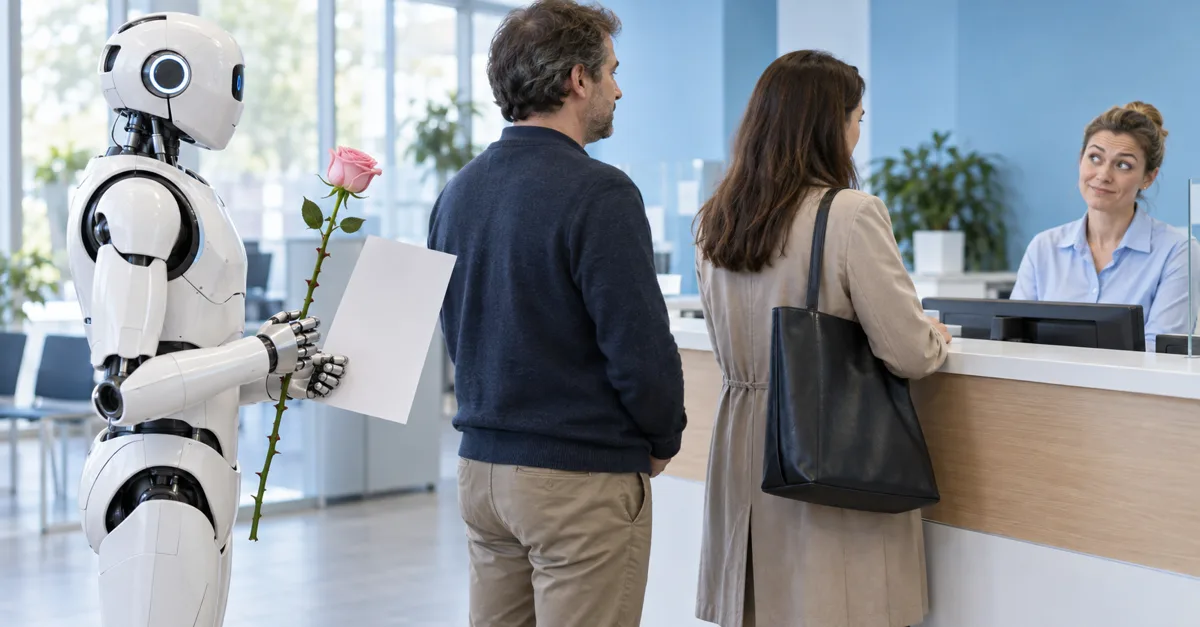
In February 2026, the Walloon chambers of commerce rose against a tax many believed forgotten: the municipal tax on motive power. A company pays according to the power of its motors, around €20 per kilowatt in the province of Luxembourg according to L'Avenir. Exempted since 2006 by the Marshall plan, it threatens to return as the regional compensation to municipalities falls. Belgium, then, already taxes machines. And that local dispute sums up the debate over the robot tax and AI: a fine idea on paper, thorns the moment you apply it.
Robot tax: an idea born well before AI
Ever since the steam engine entered English workshops at the end of the eighteenth century, every technical revolution has raised the same question: who benefits from the productivity gains? The Luddites smashed the looms. Others looked for a fiscal answer.
In France, John Mitchell formalised it in the 1990s. An IT specialist at the Saint-Denis town hall, he proposed the "ROSE levy", for Robots, Ordinateurs et Systèmes Experts, the ancestors of our AI systems. His reasoning, reported by Libération in 1998: "For equal work, employees cannot compete with machines, first because they are less efficient, second because they represent heavy social charges for the employer." His Mac/Man ratio compares the production capacity of a machine with that of a human. Hoped-for revenue: 40 billion francs, to fund the 32-hour week, support for the unemployed, and training.
In 2017, Bill Gates told Quartz that a robot doing the work of a worker paid 50,000 dollars should be taxed "at a similar level". The European Parliament nonetheless stripped the fiscal section from the Delvaux report. In April 2026, OpenAI in turn recommended taxing automated work. On 26 August 2026, Gates published on Gates Notes an essay of nearly 6,000 words: robot tax, token tax, and "Human Reserved" jobs.
The roses: a world where the machine pays in
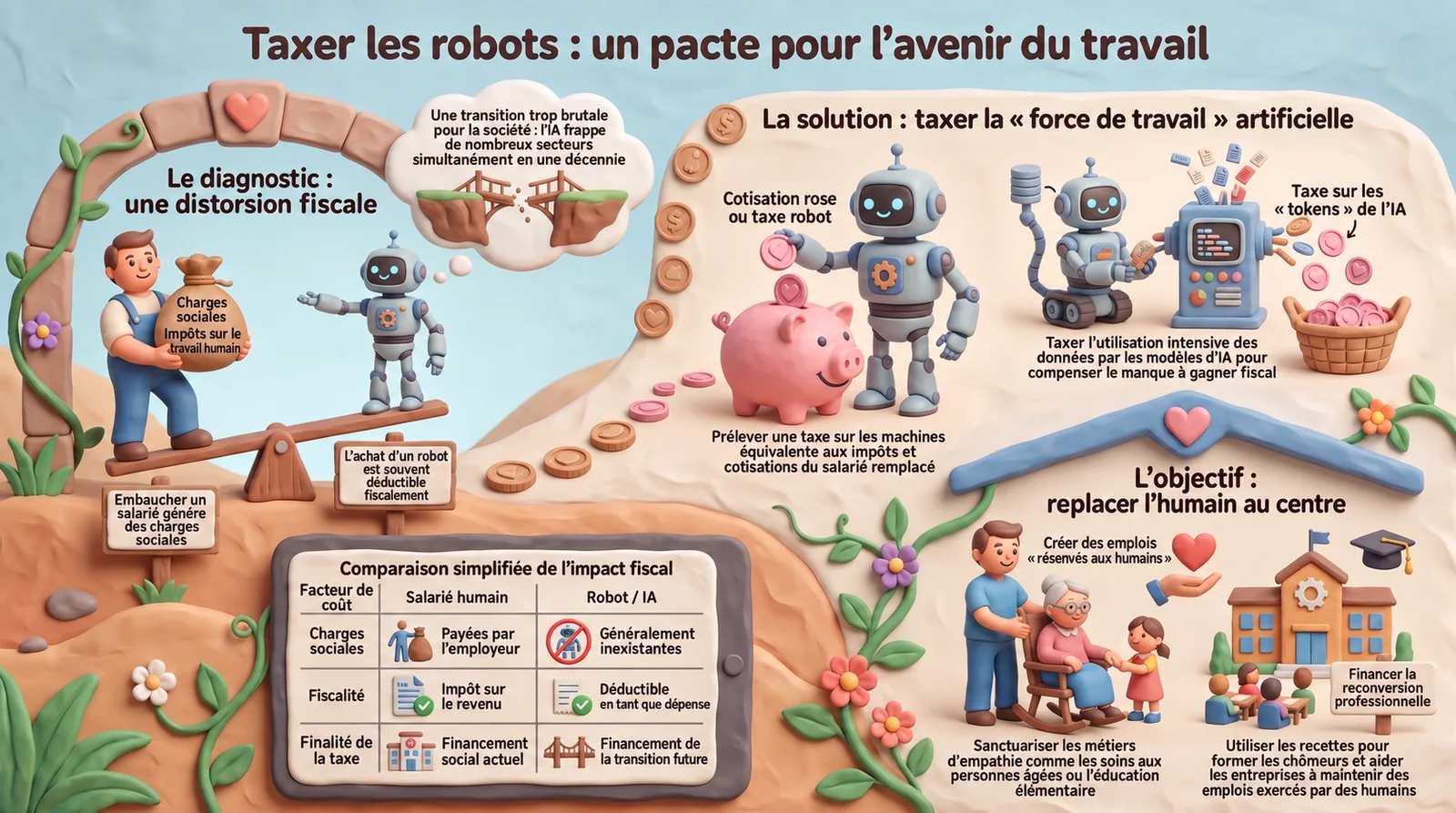
According to Gates, hiring generates charges on the salary, whereas a robot carries no charges from the moment it is bought. The employee pays in every year; the machine yields a deduction. The tax code therefore pushes towards replacing the human.
In the rose-tinted world, the machine pays on purchase and the AI pays on use, by volume of tokens. Those receipts return to the human: professional retraining, better-resourced schools, a social safety net.
The second part goes further: reserving certain occupations for humans. Gates cites announcing an incurable illness: "There is no technical reason a robot could not do it. And yet it should not." As early as 2017, he wanted those receipts directed at care for older people and support for children, where human empathy remains irreplaceable.
The thorns: defining, measuring, coordinating
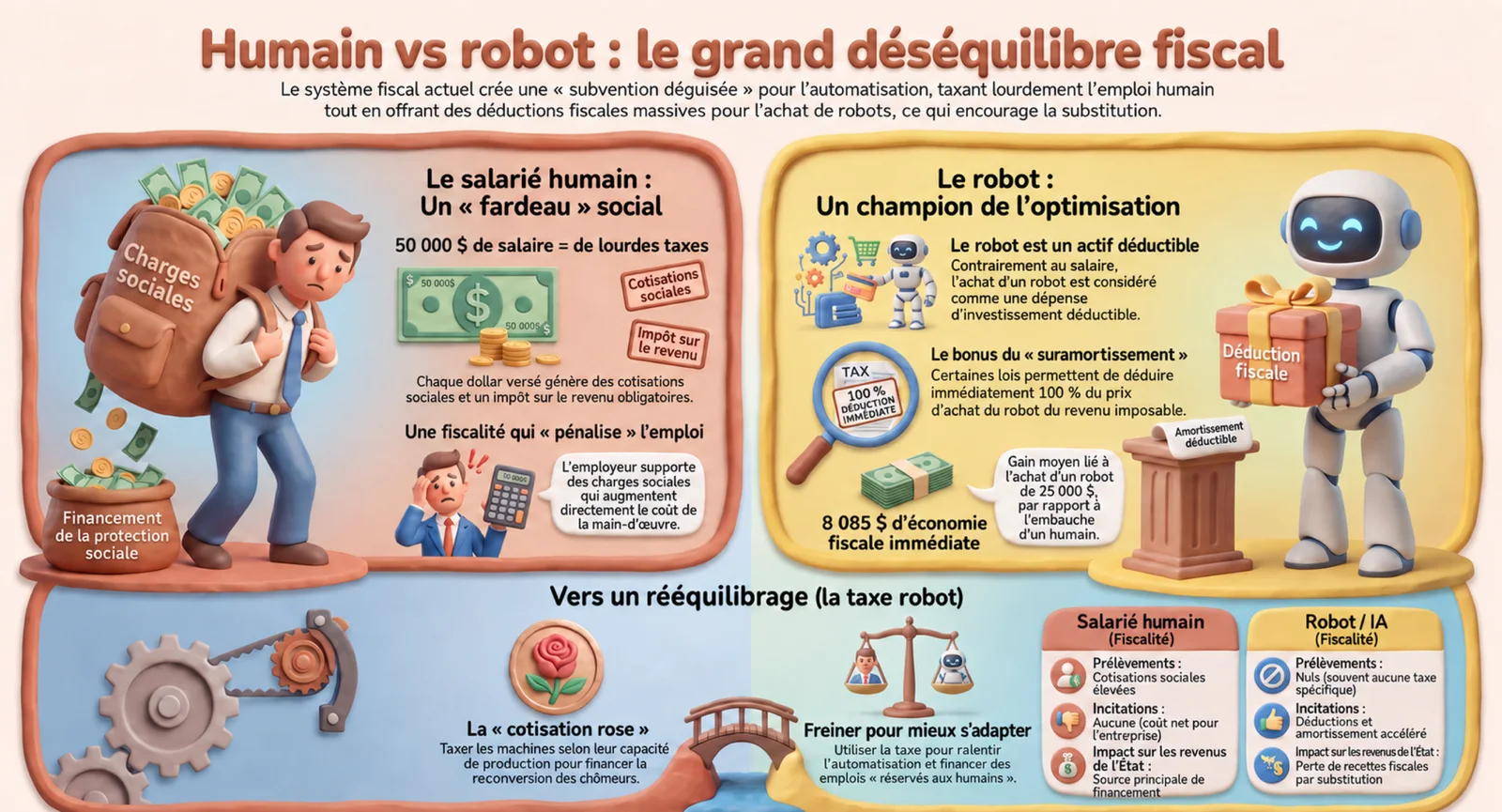
Defining the machine. A sweet dispenser, a word processor and an AI agent all replace some share of human work. A broad definition hits the tool that helps; a narrow one spares the tool that replaces.
Measuring the replacement. A robot replaces tasks, rarely a whole job. The OECD places 27% of jobs in occupations highly exposed to automation, which does not mean they will disappear. As for the token tax, Oren Etzioni, former director of the Allen Institute for AI, compares it to taxing the keystrokes of a typewriter: a classroom with an AI tutor consumes tokens continuously, while a model replacing a call centre may consume few.
Coordinating states. A country that taxes alone pushes its companies towards foreign models. "If we tax American tokens, what happens when people use Chinese models?", asks Etzioni. It is the fear that brought down the fiscal section of the Delvaux report.
Why VAT succeeded where the robot tax fails
Created in France in 1954 by Maurice Lauré, VAT applies in more than 170 countries, including 37 of the 38 OECD members. Within the OECD, only the United States does without it, using sales taxes set state by state. Three properties explain that success:
- An obvious base: the sale price.
- Built-in control: every company collects VAT and deducts what its suppliers charged, and therefore demands proper invoices.
- Neutrality at the border: exports exempt, imports taxed. Adopting VAT does not penalise exporters.
The robot tax has none of these properties. Its base is blurred, its declaration hard to verify, and it hits production rather than consumption. Without a worldwide agreement it favours the countries that do not apply it, with leakage of competitiveness and of talent as the result.
Kerosene, the other tax nobody dares
Aircraft fuel shows what happens when a tax judged necessary requires everyone's agreement. The 1944 Chicago Convention forbids taxing the fuel aboard an aircraft crossing a border, and the 2003 European directive still exempts kerosene on international commercial flights. The Commission proposed lifting that exemption in 2021. But European taxation requires unanimity among the 27, and in late 2025 the Danish presidency proposed keeping the exemption until 2035. According to RTBF, these exemptions cost around 10.7 billion euros in revenue a year.
Meanwhile the sky fills up. According to IATA, demand for air transport reached a record in 2025, up 5.3%. Every year without a decision adds flights and emissions. Automation follows the same slope: absent a worldwide agreement, nothing moves, and the machine advances without sharing its gains.
The AS3P position: humans augmented, not replaced
Replacing humans with machines and then working out how to tax the machines amounts to treating the symptom. We argue for advanced humans, equipped with tools that make them more effective and reduce their stress rather than their numbers.
An augmented team produces more. The company generates margin and pays the contributions of its staff. The fiscal machine turns, and both taxes and contributions flow back into education, health and retraining.
One condition: keeping control of the tools. When a company rents its intelligence from a large international group, part of the value leaves the territory. With a local, open source AI such as BrainDup, designed by humans for humans, the productivity stays inside the company and inside the economy that funds our schools and our hospitals.
Conclusion
The robot tax carries a fair promise: technological change should benefit people. But like the tax on kerosene, it is waiting for a worldwide agreement that never comes. Every company can, without waiting, make AI a tool that augments its teams rather than a substitute that displaces them.
That is the purpose of our AI training: teaching your staff to work better with AI. To discuss it, book a meeting or write to us.
Sources
- Libération (22 May 1998): "L'homme qui voulait taxer les robots", in French
- Quartz (17 February 2017): "The robot that takes your job should pay taxes, says Bill Gates"
- Europaforum Luxembourg (February 2017): on the Delvaux report on robotics, in French
- PYMNTS (April 2026): "OpenAI Calls for AI Taxes to Protect Safety Nets"
- Gates Notes (26 August 2026): "A Turbulent AI Era and Critical Choices to Make"
- TechCrunch (26 August 2026): "Bill Gates wants to see a robot tax and 'Human Reserved' jobs to mitigate harms from AI"
- ABC News (27 August 2026): "Bill Gates diagnoses problems with AI, but an expert questions his prescription"
- OECD (July 2023): Employment Outlook 2023, artificial intelligence and the labour market, in French
- OECD (2024): "Countries with VAT", Consumption Tax Trends 2024, in French
- RTBF (5 November 2025): on keeping the fuel tax exemption until 2035, in French
- IATA (29 January 2026): strong passenger traffic in 2025 overshadows persistent capacity constraints
- L'Avenir (24 February 2026): the chambers of commerce against the tax on motive power, in French