
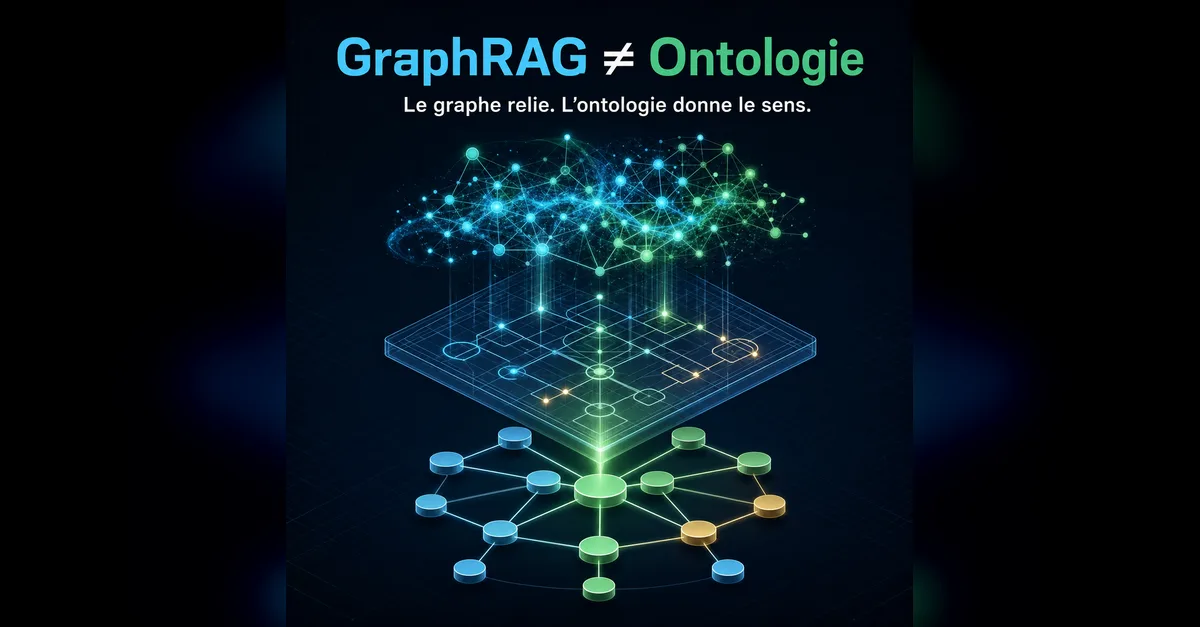
In 2026 Palantir, Microsoft and Google published three enterprise AI architectures that rest explicitly on an ontology. Twenty-five years after the founding paper of the semantic web. Here is why that turn was predictable, what it demands technically, and what an implementation that is genuinely available today looks like.
1. Three signals converging, within a few months
The vocabulary of the platforms has changed.
Palantir puts the Ontology at the heart of the AIP architecture. The documentation describes it as modelling the "nouns" and the "verbs" of operational processes, in a form readable by humans and by agents alike, and announces an engine able to "query billions of objects, orchestrate tens of thousands of actions, and continuously incorporate learning from experience" [1].
Microsoft introduces an Ontology item in Fabric IQ, in preview. The official documentation is explicit: the ontology "defines the core business entities, relationships, properties, rules and actions", and "agents understand what actions are available and how to invoke them" [2]. An NL2Ontology layer turns natural-language questions into structured queries.
Google Cloud documents the Yahoo case: an agentic media-buying platform built on two distinct graphs. A knowledge graph in Spanner Graph carries operational truth, products, inventory, contracts, governance controls, with policies written in as versioned relationships rather than buried in application logic. A context graph in BigQuery Graph carries a decision-trace ontology, that is, the auditable lineage of every judgement the agent makes [3].
Three vendors, three architectures, one shared intuition. And a formulation worth keeping, from Swapnil Patel (Yahoo): "As the industry moves from systems of intelligence to systems of action, the constraint on autonomous AI shifts from model capability to whether an enterprise can trust what an agent does without supervision" [3].
2. What these platforms are rediscovering was set down in 2001
None of this is new conceptually.
Tim Berners-Lee, who invented the web, set out in May 2001 in Scientific American, with James Hendler and Ora Lassila, the idea of a web whose data machines can interpret. In 2007 he popularised the phrase Giant Global Graph: no longer a network of documents joined by links with no meaning, but a network of typed facts.
The technical stack that follows has been settled for a long time: URIs for identity, RDF for the subject, predicate, object triple, RDFS and OWL to declare what can exist, SPARQL to query. OWL became a W3C Recommendation in 2004, OWL 2 in 2009, second edition in 2012.
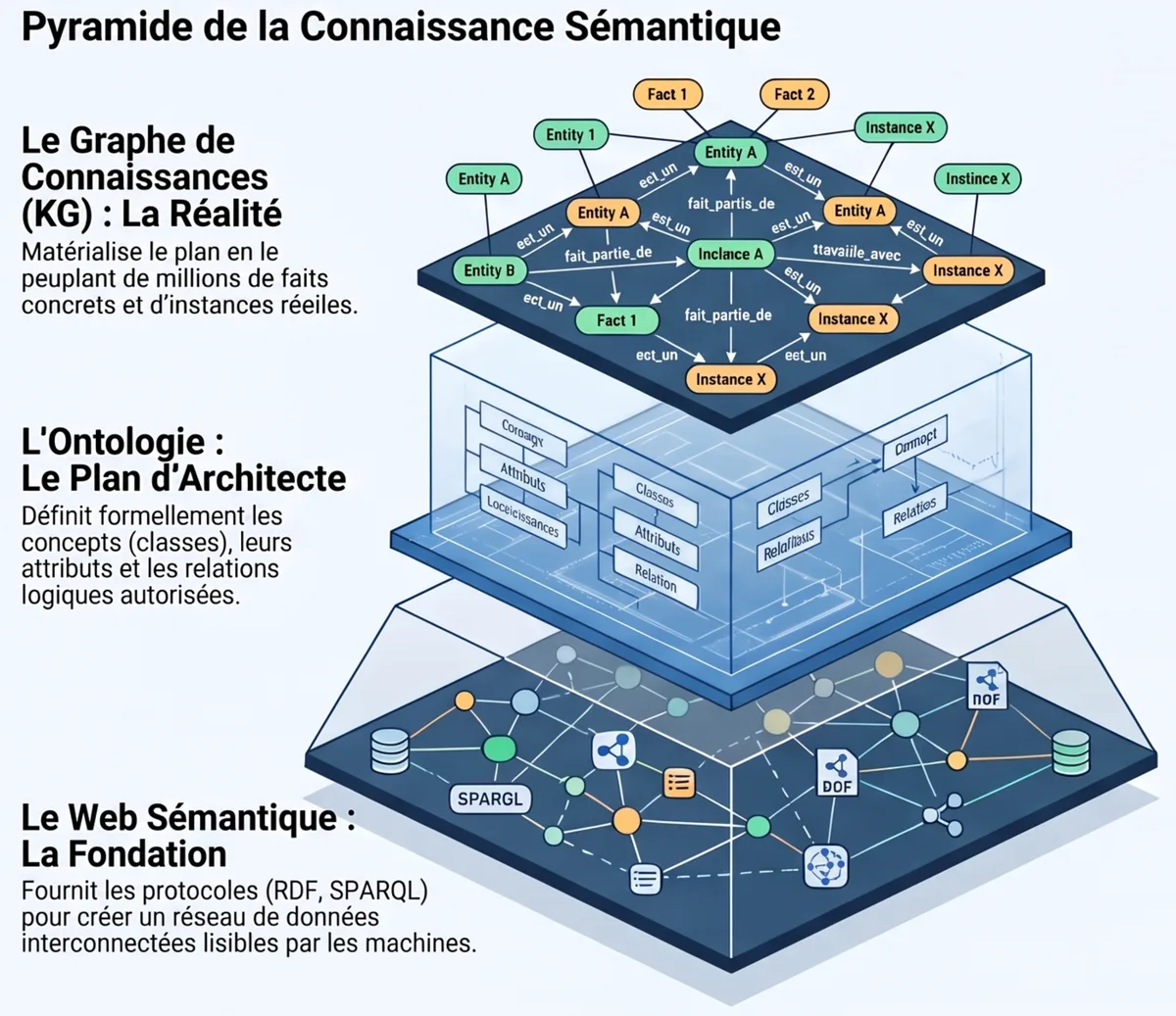
On the French-language side of knowledge engineering, Charlet, Bachimont and Troncy set down as early as 2004 the definitions that still carry authority [4]. Two of them bear directly on today's debate:
"To build an ontology is also to decide how objects are and how they exist."
"An ontology is a specification that partially accounts for a conceptualisation."
That "partially" is not rhetorical weakness. It names the ontological commitment: the gap one accepts between the interpretive richness of a domain and what a computable logical theory can formalise of it. It is exactly the question an architect faces today when deciding which actions an agent will be allowed to perform.
The same authors already described building ontologies from text corpora, in four steps of which the first is the primacy of the corpus and the second semantic normalisation. Twenty-two years on, that is precisely the pipeline being redeployed, with a statistical extractor added.
3. Why now: LLMs lift the economic lock, and create the need
The historic problem with ontology was never theoretical. It was economic.
Building an ontology required a knowledge engineer and a domain expert, along a long chain: identify the concepts, define the classes, the hierarchy, the relationships, the constraints, align, validate, maintain. Too expensive for most organisations. The result: a method recognised as excellent, and little adopted.
LLMs move that lock in two opposite and complementary ways.
Upstream, they cut the cost of writing. Concept extraction, entity and relationship extraction, drafting a schema, generating a first OWL representation: all steps that are now assisted. Work published in 2025 and 2026 measures that assistance against sets of competency questions, with a qualified result: the models cover more questions than novice students, but still produce incorrect axioms and redundant elements. The assistance is real; validation stays human and tool-supported.
Downstream, they create the need. A language model has no stable model of the world. Put in front of a company's document estate, it cannot settle on its own questions that are nonetheless structural: does Account mean a bank account or a customer account? Is the Customer to Account relationship 1:N or N:N? Can a cancelled order still carry a shipment? May a salesperson amend a contract? Those answers cannot come from the model's priors. They have to come from an explicit declaration, shared and versioned.
And with agents the stakes change in kind. A conversational assistant that is slightly wrong produces a false answer. An agent that is slightly wrong executes cancel_order(), transfer_funds(), change_supplier(). Which brings back a classic idea from AI: World Model plus Action Model.
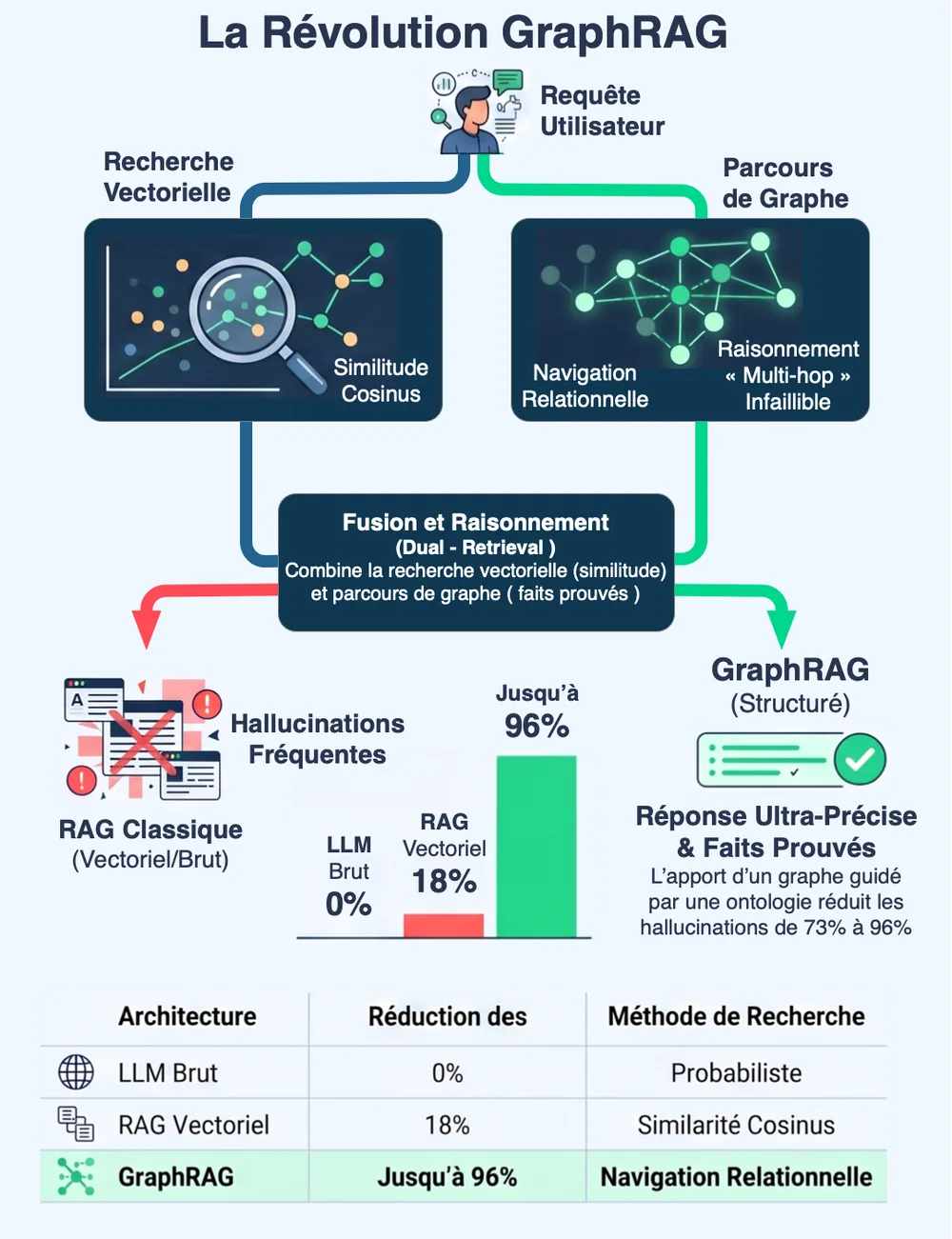
One point deserves emphasis, because it is confused on a massive scale online: GraphRAG is not an ontology. Microsoft GraphRAG's default indexing workflow has an LLM extract entities and relationships, builds a graph, detects hierarchical communities (Leiden) and generates community reports. No OWL ontology is required upstream. The accurate formulation is this: GraphRAG gives the LLM a graph; the ontology gives that graph a stable semantics.
4. What this demands of an architecture, concretely
If the three examples in section 1 are taken seriously, the semantic layer has to satisfy five requirements, not one:
- A declared vocabulary, prior to ingestion, in a standard format a business expert can read back;
- An enforceable boundary between what the model proposes and what the system admits;
- A version lock: knowing under which ontology a piece of data was produced, and under which ontology an answer was framed;
- An auditable decision lineage, distinct from the knowledge graph itself, which is the lesson of Yahoo's dual graph;
- Governance of rights built into the semantics, not bolted on afterwards.
That is an architect's specification, not a vendor's pitch. It is verified in the code, or it is not verified at all.
5. BrainDup: the same model, sovereign, and already implemented
BrainDup is the KG-RAG foundation developed by AS3P. Its design predates the 2026 announcements and follows exactly the same line. The points below are verifiable in the repository.
The ontology is written in OWL, not in configuration. Each domain is described in a Turtle file (TTL) declaring classes, properties, domains and ranges, plus a set of proprietary annotations (bdup:) carrying the projection onto the foundation, deterministic identity and extraction hints. The generic POLE+O core exposes five universal bases, Person, Organisation, Location, Event, Object; the domain packs do not replace them, they specialise them through multi-labels. The heritage pack, in production on a corpus of 921 regional press documents, declares 19 types, 17 relationships and 4 event types, aligned with CIDOC CRM (ISO 21127) and RiC-O. The insurance pack is built on LKIF, completed by institutional theory (brute facts versus institutional facts, agencies, arrangements, things, and the instituting, consequent, terminating lifecycle).
The TTL is compiled, never interpreted hot. rdflib lives at build time and does not enter the runtime. Compilation produces a JSON manifest validated by a closed contract (extra="forbid" at every level): a key outside the contract is not ignored, it is refused. The boundary between what to extract (declared by the pack) and how to extract it (thresholds, passage anchoring, event mechanics, shared code) becomes structural rather than a matter of convention.
Compilation is a quality gate, not a conversion. Four families of blocking checks apply to the TTL: identifiers without accents, a mandatory French label on every exposed relationship, consistency of domains and ranges, dangling equivalences, a property pointing at itself, instances outside the declared domain. A pack that fails is not degraded, it is not compiled. And a TTL modified without recompilation fails continuous integration, never production.
The pack is locked at the birth of the corpus. The active ontology is not a configuration field but an INSERT-only journal in the database: state is derived from the last event. Every ingestion job carries the ontology_epoch under which it was queued, and the worker refuses to process a job from another epoch. A SHA-256 fingerprint of the manifest is compared at startup: if the activated pack has been recompiled since, the process refuses to project rather than mix two vocabularies in one graph. That is deliberate fail-closed behaviour.
The answer trace carries the ontology. Every answer produced records not only the passages, entities and relationships used, but also the identifier and version of the ontology under which the process answered. At the scale of a document foundation, that is the equivalent of Yahoo's context graph: the decision lineage, separate from the knowledge graph.
The guiding principle fits in one sentence: the LLM proposes, the code decides. The model extracts and writes. Deterministic code arbitrates: an entity enters the graph only if it matches a type declared by the pack and can be tied to a specific passage of the source document. Citations are assembled by the code from the catalogue, never written by the model. Zero passages found means an honest refusal, without even calling the LLM. Prose with no attested passage means a refusal too.
Three databases, one semantic contract. PostgreSQL carries transactional truth, rights, versions and audit; Neo4j carries the graph; Milvus carries the vector memory. These are not three silos but three projections of one contract. Rights are part of it: AGDLP method, a single decision service, then native enforcement per database, vector pre-filtering, security clauses generated in the graph, Row-Level Security in SQL. Revoking a right takes effect immediately by removal from a group, with no reindexing.
The whole thing is sovereign. Local inference, no corpus data to any third party, a sovereignty check wired into the continuous integration chain, deployment possible in a disconnected environment.
6. Correspondence table
| Requirement | Palantir AIP | Fabric IQ | Yahoo / Google | BrainDup |
|---|---|---|---|---|
| Declared business vocabulary | Ontology | Ontology (preview) | Typed graph ontology | Compiled OWL/TTL pack |
| Actions and rules | First-class actions | Rules and actions | Policies as versioned relationships | Closed contract plus code guards |
| Grounding of agents | Ontology SDK | Structured grounding, NL2Ontology | Spanner Graph | KG-RAG, citations assembled by code |
| Decision lineage | Continuous learning from experience | Governance of definitions | Context graph, BigQuery | Query trace stamped with the ontology |
| Sovereignty and hosting | Vendor cloud | Vendor cloud | Vendor cloud | Local, sovereign, disconnectable |
7. What BrainDup does not do, and why we say so
The credibility of a foundation is measured by its declared non-goals as well.
BrainDup carries no OWL reasoner at runtime. Transitive closures are computed by derivation in code, explicitly and testably, rather than delegated to a reasoner whose behaviour depends on how clean the data is. That is a trade-off between expressiveness and predictability, made deliberately and documented.
BrainDup makes no claim on the worldwide semantic web. The object is a private knowledge graph, bounded by one organisation's corpus. Berners-Lee aimed at a planetary graph; history has shown that the semantic web came about in islands, wherever rigour is vital: health, law, finance, heritage, industry. BrainDup builds one of those islands, per organisation.
Finally, the catalogue of domain packs is unevenly mature: two packs are compiled and operational, eight more are modelled in TTL and await their pass of graph annotations. The work remaining is modelling, not software engineering, and it can be costed.
8. Conclusion
The author of the article that prompted this note concludes as follows: the future is probably not a plain return to OWL, but a semantic and operational layer anchored to the ontology, connecting domain models, live data, action contracts, policies and execution controls; a kind of "semantic operating system" between the AI systems and the company's resources.
That is a good description. It is also, word for word, what a governed KG-RAG foundation already implements, at a scale that is not a hyperscaler's but that of a mid-sized company, a professional practice, a local authority or a regulated profession.
The question facing boards in 2026 is therefore no longer "do we need an ontology". It is: who owns yours, where does it run, and can you prove, query by query, under which version it answered?
To test these requirements against your own document estate, book a meeting or write to us.
Sources
- Palantir, AIP Architecture, Foundry Architecture Center. palantir.com
- Microsoft, What is Fabric IQ?, Microsoft Learn. learn.microsoft.com
- Google Cloud, Graph technologies underpin Yahoo's system of action, June 2026. cloud.google.com
- J. Charlet, B. Bachimont, R. Troncy, Ontologies pour le Web sémantique, journal I3, special issue on the semantic web, 2004, in French. HAL: hal-03854420
- T. Berners-Lee, J. Hendler, O. Lassila, The Semantic Web, Scientific American, May 2001; T. Berners-Lee, Giant Global Graph, 2007.
- W3C, OWL Web Ontology Language (Recommendation 2004), OWL 2 (2009, second edition 2012).
- Survey article Why Ontology Is Making a Comeback in the Age of LLMs (2026), for the ESWC 2025, EMNLP 2025 (OG-RAG), ACL 2025 (ORT) and ACL 2026 (OntGQA) references.
Further reading
- Sovereign company AI: BrainDup stays with you
- The AI Act: how BrainDup answers it, article by article
- Multilingual multimodal RAG: why your AI ignores your non-English documents
Jean-Marc André, AS3P. BrainDup is a sovereign KG-RAG foundation for organisations that must be able to prove what their AI asserts.